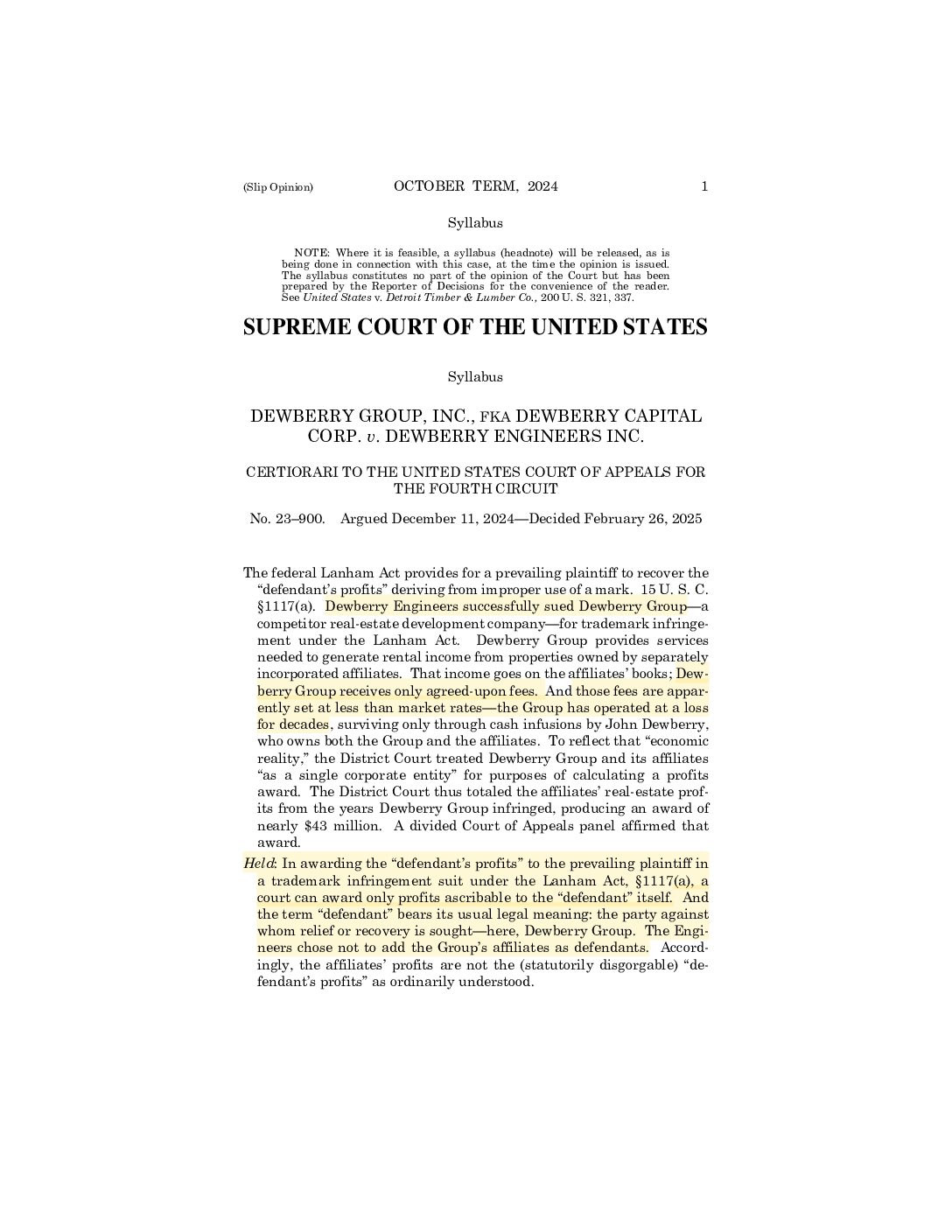
This new SCOTUS decision allows many trademark law practitioners to breathe a sigh of relief. It overturns District and Fourth Circuit decisions which held that, when calculating damages for trademark infringement, one could also take into account revenues being earned by affiliate companies under the same corporate umbrella, who are not the actual infringer.
Had this circuit court decision not been addressed, it would have wreaked havoc on the application of many other laws by creating a new, far more capacious definition of the word “Defendant” to encompass completely separate entities that share common owners with the actual defendant.
In the specific context of trademark damages and this particular case, I expect that the plaintiffs will have two more bites at the apple. On remand, the district court may seek to apply the “just-sum” provision of the Lanham Act to go after the money earned by affiliates of the defendant when calculating the amount that the infringer profited from use of the trademark.
And, apparently, there was no effort at the trial court level to seek to pierce the corporate veil between the defendant and its affiliated entities. SCOTUS notes that the infringing defendant was paid less than market rates and has operated at a loss for decades, surviving only through cash infusions by a parent. This suggests it may be under-capitalized, which is a sign that the veil may have beeb pierced. I have not studied procedurally whether it is too late the case for plaintiff to pursue that line of argument.
No, you are not your (affiliate) brother’s keeper…. at least in the eyes of trademark law.
Published on: